You ask for a summary of a difficult topic, receive a clear explanation, and finish reading with the feeling that you understood it. The next day, however, you cannot explain the topic without reopening the conversation. The answer was useful; the problem is that recognizing a ready-made explanation is not the same as producing an answer of your own.
Using AI to study better does not require abandoning summaries or turning every session into a test. It requires deciding which part of the work belongs to you. In this guide, we follow a fictional student through a study session: she reads, tries to explain, identifies a question, uses AI to receive questions and feedback, checks the material, and returns to the topic later. The method works with paper and a simple chat; it does not depend on uploads, memory between conversations, or calendar integration.
AI can help you study—but should not do the most important part
An assistant can organize topics, offer another explanation, formulate questions, and compare an answer with criteria you provide. That is support. Remembering an idea, explaining it in your own words, solving a problem, and understanding why you got it wrong are actions that require your participation. If the tool delivers every step before you try, there is little left to observe about what you really know.
A practical rule is to separate help with thinking from an answer in your place. In the first case, you bring a specific question, an attempt, or an answer and ask for feedback that lets you continue. In the second, you ask for the complete solution, copy it, and move on without being able to reproduce the reasoning. There are times when consulting a solution makes sense—for example, after trying and identifying where you got stuck. The order matters more than an absolute prohibition.
This distinction also avoids treating every interaction with a chat as “active learning.” Reading an answer, even while asking questions, can still be a passive activity. Participation appears when you retrieve something from memory, build an explanation, compare ideas, or solve a question before seeing the answer key. AI can facilitate these opportunities; it does not perform them for you.
Start by trying before asking for the answer
Imagine Lia, a fictional student who has just read a few pages about the water cycle. She recognizes words such as evaporation and condensation but cannot explain the difference between the processes. Instead of asking “summarize the chapter,” she closes the material and writes two sentences: “Water evaporates, forms clouds, and then returns as rain. Condensation is when water cools down.” She is heading in the right direction, but the second sentence still does not clearly say what changes state.
This attempt does not have to be polished or complete. It serves as a diagnosis. Without looking at the text, Lia can mark the part where she hesitated with a question mark and write: “What becomes liquid? Does every cloud produce rain?” Only then does she open the assistant. She does not need to send the entire page or information about her school; describing the topic and pasting her own attempt is enough.
Request 1—evaluate the attempt: “I am studying the water cycle. First I tried to explain without consulting anything: ‘Water evaporates, forms clouds, and then returns as rain. Condensation is when water cools down.’ Do not rewrite everything for me. Say what seems correct, ask up to two questions about what is imprecise, and wait for my answer before explaining.”
If a ready-made answer arrives despite the request, Lia can interrupt and ask for only the questions. Control of the session lies not in a perfect prompt, but in what she does with the response. If you are still learning to talk to an assistant, the guide to getting started with ChatGPT helps with the basics of interaction; the study process here does not depend on one brand.
Use AI to find gaps in your understanding
After answering the questions, Lia asks the assistant to separate three things: what her explanation already covers, what is incomplete, and what needs checking in the material. This division is better than receiving a “corrected” version and ending the topic. A ready-made answer can hide the distance between the idea Lia had and the idea she read.
Request 2—locate gaps: “Compare my explanation and my answers with these points from the material that I wrote down: evaporation turns liquid water into vapor; condensation turns vapor into small liquid droplets; clouds can produce precipitation. Separate: (1) correct points, (2) incomplete or confusing points, (3) one question for me to answer without consulting anything. Do not invent passages from my book or attribute anything to it that I did not provide.”
The factual points in this example match the U.S. Geological Survey explanation of evaporation and the USGS explanation of condensation. In actual studying, Lia should prefer the course material to understand the expected level of detail. AI has not seen the book just because it received the topic name; if it says “on page 32 the author states…,” she needs to check before accepting it.
Lia’s gap becomes more precise: she had mentioned cooling, but not that vapor turns into liquid water. She rewrites one sentence herself. For the session’s purpose, this small correction is worth more than copying a long explanation she would not be able to retrieve later.
Ask for another explanation when needed—but return to the material
A specific question may remain after the first attempt. In that case, asking for an analogy, an everyday example, or a comparison between concepts can help. The answer should illuminate the difficult point, not replace reading. Analogies simplify: they help you begin but can hide important conditions or exceptions. That is why Lia checks the new explanation against her notes and the text she is studying.
Request 3—clarify a point: “I still confuse evaporation and condensation. Explain the difference in simple language and give an everyday example of each process. Then show in one sentence where the comparison is no longer sufficient. Do not claim you consulted my book; I will check the answer in the material.”
Lia can then return to the page and explain in her own words what changes in each process. If the assistant and the material disagree, she does not have to choose based on how fluent the answer sounds. She can consult the teacher, an appropriate source, or another reliable reference. For topics involving calculations, standards, or controversial concepts, this checking is even more important.
Turn content into questions you answer before seeing the answer key
After understanding the passage better, Lia needs to discover whether she can retrieve it without support. She closes the book and asks for short questions, one at a time. One question might ask for a definition; another, a comparison; a third might present an incorrect explanation so she can locate the problem. The assistant shows criteria or an answer only after she tries.
Request 4—practice retrieval: “Create three questions about evaporation and condensation: one asking for an explanation, one asking for a comparison, and one containing an error for me to identify. Ask one question at a time. Do not show the answer key before my response. After each attempt, say what I should check in the material.”
Lia answers: “In evaporation, liquid water becomes vapor; in condensation, vapor becomes liquid.” This is more informative than “one goes up and the other goes down.” If she cannot remember, she can write “I could not do it” and review. Getting a study question wrong is a clue about where to return to the content, not a definitive judgment of her ability.
There is support for this kind of practice, but it is important not to attribute it automatically to AI. In experiments with texts, Roediger and Karpicke observed better retention on delayed tests after recall tests than after repeated rereading, under the conditions studied. A review of study techniques rated practice testing and distributed practice as highly useful strategies. These studies support the decision to try to remember and revisit the topic; they do not demonstrate that using a chatbot by itself improves grades or guarantees learning.
Ask for feedback on your answer, not just the correct answer
When Lia answers, the most useful feedback is specific. “It is wrong” does not say what to adjust; a complete solution before comparison can end the attempt too early. She asks the assistant to identify the appropriate part, what is missing, and where to check, leaving the final reformulation to her.
Request 5—review an answer: “My answer was: ‘In evaporation, liquid water becomes vapor; in condensation, vapor becomes liquid.’ Evaluate this answer to the question about the difference between the processes. Separate what is correct, one detail that may be missing, and one point for me to check in the material. Do not write my final answer; I will reformulate it.”
If the assistant identifies a problem, Lia looks for the corresponding passage in the book. If she finds no support for the criticism, she does not automatically incorporate it. AI tools can sound confident when they are wrong or when they demand a detail that was not part of the question. The teacher and course criteria remain relevant. After checking, Lia answers again without looking. This second attempt—not the chat’s evaluation—shows whether she has made progress.
The same applies to worked exercises. Asking for a hint for the next step can help; asking for complete solutions to every problem and merely following the reasoning creates a fragile impression of mastery. If the subject requires a specific technique, try applying it to a new question without leaving the example open.
When a summary helps—and when it gets in the way
A summary can serve as a map: showing the chapter’s topics, organizing a quick review, or helping you compare subjects. Lia can make a small summary after reading and trying to explain, using it as a record of what she understood. She can also ask the assistant to identify repetition or order topics she wrote down herself.
The risk appears when the summary becomes your only contact with the topic. A short version may omit an important condition, oversimplify a relationship, or contain an error. Even a correct summary can be recognized without being remembered. Before using it as a foundation, compare it with the material and try to answer at least one question without consulting it. If you cannot, return to the original passage instead of asking for another increasingly short summary.
This is not a contest between reading and technology. In one session, a summary can be the entry point; in another, the final map. The criterion is whether it helps you return to and work with the content, or merely replaces that contact.
If you need to work through a long study handout, see the method for summarizing PDFs and checking the result against the original. Once you understand the passage and want to practice without looking, the guide to questions, quizzes, and flashcards explores that stage further.
Build an AI-assisted study session without handing over the studying
A 35-minute session may be enough to work on a small passage, but that time is only an example. Lia uses the first ten minutes to read and mark a question; then she closes the material for five minutes and writes her explanation. She sets aside a few minutes for questions and a targeted explanation. Then she answers without consulting anything, checks uncertain points in the book, and writes a question to review another day. If she needs more reading time, she reduces the number of questions. If she already knows the topic, she devotes more time to retrieval or application.
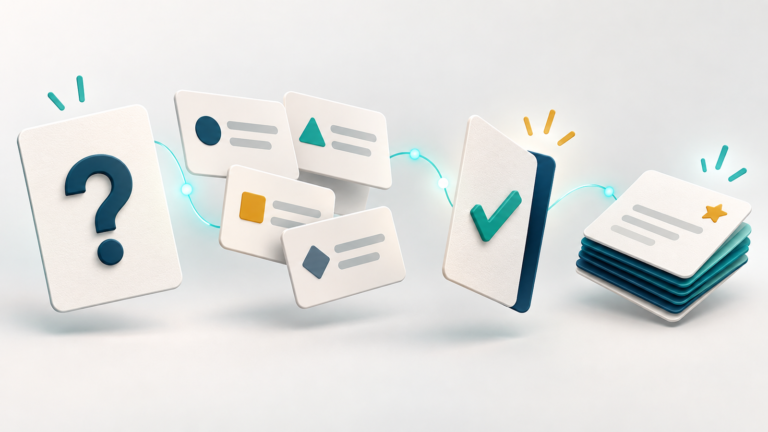
The sequence is simple: understand, try, question, retrieve, check, and review. It is not a universal formula and does not require a stopwatch. A subject with mathematical problems may need more solving time; a conceptual reading may need more explanation aloud. What should not disappear is an attempt of your own and a check outside the chat.
Request 6—prepare the next review: “Today I studied a passage about evaporation and condensation. I got the difference between the processes right, but I still hesitate when explaining how condensation contributes to cloud formation. Suggest two questions for me to answer in another session, without an answer key now. Do not say you tracked my progress; use only what I provided.”
The assistant does not need to store this conversation for the plan to work. Lia records the questions in her notes and returns to them later. The AI study planner can help distribute reading, practice, and review sessions according to available time; the tool organizes a plan but does not automatically measure what she learned. To explore other content on this subject, the AI for studying hub brings together resources in this area.
Signs that AI is studying in your place
Some signs deserve a pause: you ask for the answer before trying; read an explanation that feels familiar but cannot reproduce it; use a summary without returning to the material; receive the complete solution to every exercise; or need to reopen the chat to remember every step. None calls for guilt or abandoning the tool. They indicate that it may be time to reduce the help and test what remains when the conversation is closed.
A small correction already changes the session. Before opening the assistant, write what you know and what you do not. When asking for help, request a hint, a question, or identification of a gap. Then close the chat and try again. If the subject is too new for any attempt, do some guided reading first; the attempt does not have to precede your initial contact with the content.
It also helps to respect the activity’s rules. Courses, teachers, and assessments may permit different AI uses or prohibit them. Check the applicable instructions and do not submit generated text as if it were entirely yours. To study privately, do not send passwords, classmates’ data, private exams, personal documents, or restricted institutional materials. Use only passages you can legitimately share; many questions can be formulated without attaching any file. UNESCO’s guidance on generative AI in education also emphasizes data protection and a human-centered approach.
Try it today with a small piece of content
Choose a short passage from your material. Read normally; then close the text and explain the idea in three or four sentences, even if they are incomplete. Mark where you hesitated. Bring this attempt—without unnecessary data—to the assistant and ask it to identify a gap without delivering the whole answer. Check the suggestion in the material, answer one question without consulting anything, and record what you still do not know. In another session, try answering again before rereading.
If AI helped you formulate a better question, verify an error, and return to the topic with greater clarity, it fulfilled its supporting role. The most important sign is not the quality of the answer in the chat, but what you can explain, solve, or question when it is closed.