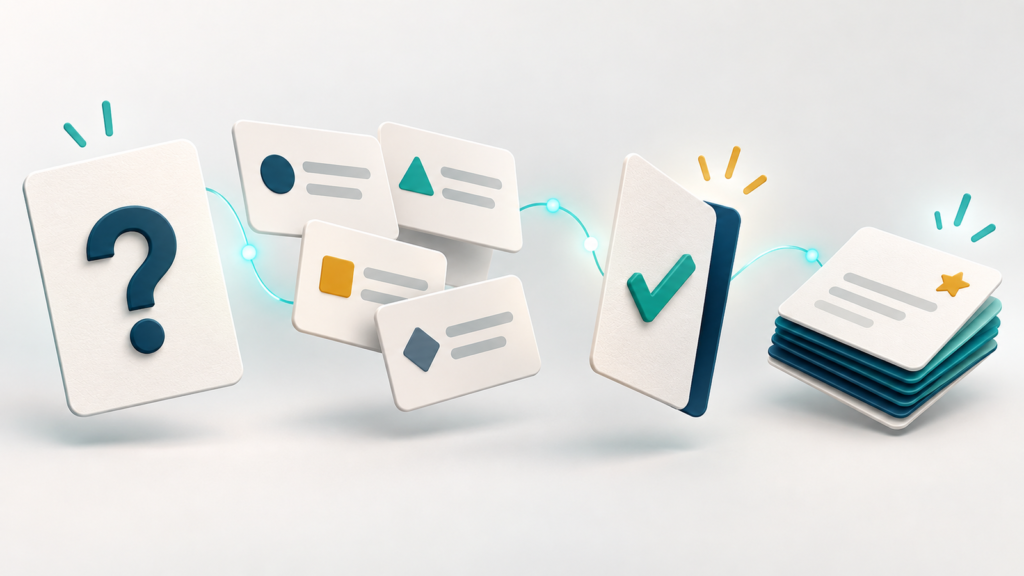
You finish studying a page of your handout, close the material, and think: “I understood.” But could you explain the topic without looking? Asking AI for another summary may make the text more familiar without showing what you actually remember. Questions, short quizzes, and flashcards create an attempt to answer—as long as the questions are faithful to the material and you check the answer key.
In this guide, AI helps prepare practice material, not study in your place. The path is to choose a passage already studied, produce questions with different purposes, review their quality, try answering before seeing the solution, and return to the source when unsure. The method works for your own notes, checked summaries, and content you have permission to share.
Why turn content into questions?
When rereading an answer, you may recognize it and feel you know the topic. Trying to formulate it from memory is a different task: it exposes what you can retrieve and what remains confusing. Research on retrieval practice and a review of study techniques support practice tests and distributed review in various contexts. They do not show that any AI-generated quiz automatically improves learning.
For a question to be useful, you need prior contact with the content, an attempt to answer without consulting anything, feedback you receive or seek, and a check against the original material. An ambiguous question, incorrect answer key, or obvious answer can give a misleading impression of progress. The value lies in the complete cycle, not the number of cards produced.
If you are just beginning to study the topic, read and work with the content first. The guide How to study better with AI without letting it do the learning for you explores this difference between support and outsourcing your reasoning. Here the focus is the next stage: creating verifiable review activities.
Start with the material you actually studied
Let us follow Camila, who studied a fictional page about relationships in an ecosystem. To keep the example controlled, her small source text contains only these ideas: producers make organic matter from environmental resources; consumers obtain matter and energy by feeding on other organisms; decomposers act on dead organic matter and return nutrients to the environment; a food chain represents a sequence of feeding relationships. These are simplified definitions for this demonstration, not a real handout or an exhaustive description of ecology.
Camila reads this passage and checks that she understands the terms. Then she gives AI the content she can share, without asking “create a complete ecology quiz,” which would leave room for unstudied topics. Her first request defines the source: “Use only the supplied material. Create five short review questions about the relationships between producer, consumer, decomposer, and food chain. Do not show answers yet. If information needed to answer a question is missing, flag it rather than filling it with external knowledge.”
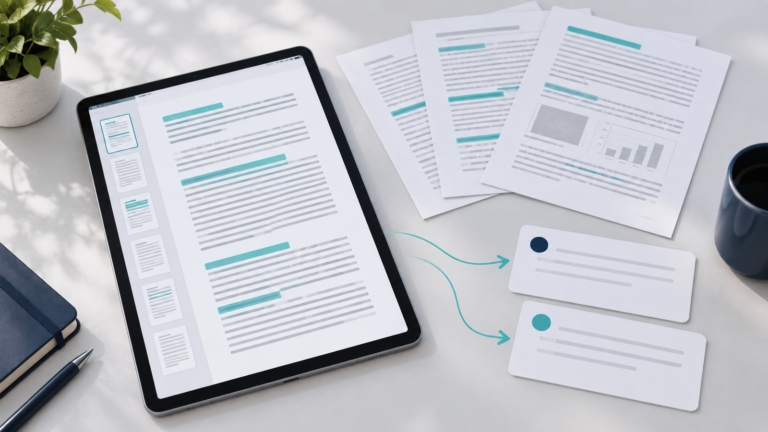
If she is using a summary, she first needs to check it against the original. A summary that lost an exception will generate equally incomplete questions. In How to summarize PDFs and study materials with AI, we show how to maintain this connection with the source document. For private exams, classmates’ data, or restricted institutional material, Camila can write her own authorized notes without sending the file.
Create different questions to test different things
Not every question requires the same effort. A recall question retrieves a definition: “What is the decomposer’s role in the studied passage?” An explanation question asks for your own sentence: “Why does a consumer depend on other organisms to obtain matter and energy?” A comparison question distinguishes concepts: “How do producers and consumers obtain organic matter in the source material?”
An application question presents a new situation but must remain answerable from the passage: “If an organism feeds on another, which described role does it fit?” Error identification presents a sentence for analysis: “Decomposers produce organic matter in the same way as producers: what is wrong with this statement according to the material?” In that last case, it is especially important to check that the sentence does not mix simplifications or create an opposition the text does not support.
Camila does not need to turn every definition into five versions. She selects questions that reveal different gaps. To vary difficulty without merely lengthening the wording, she asks: “Based only on the passage, propose a sequence of three questions: one for recall, one for explanation, and one for application. Do not introduce absent concepts. Separately indicate which passage supports each answer, but keep the answer key hidden until I try answering.” AI’s indicated passages also need checking.
How to build a short quiz with AI
A quiz is an organized round of questions with instructions and correction, not just loose questions in a list. Camila can combine short answers, true or false with justification, and multiple choice. Five questions are enough to illustrate a first round, not an ideal quantity for everyone. What matters is that each has a clear objective and a verifiable answer key.
Her request could be: “From the supplied material, build a five-question quiz: two short-answer questions, one true-or-false question requiring justification, and two multiple-choice questions. Vary recall, comparison, and application. Use only the passage; do not show the answer key now. For multiple choice, make plausible options and only one correct answer. Present the answer key in a separate section for later checking.” If the tool cannot truly hide that section, Camila copies only the questions elsewhere before practicing.
She answers without opening the solutions. Then she compares each answer with the material. Selecting an option by elimination does not mean being able to explain the concept; in that case, an additional open-ended question reveals more. If the quiz includes a topic absent from the passage, the question is removed from the round or marked as additional research—it does not become an unannounced requirement.
How to avoid poor multiple-choice questions
Poor options give away the answer key. Be suspicious when the correct option is much longer, the others are absurd, an absolute word like “always” appears without reason, the question’s grammar fits only one option, or the right answer literally repeats a sentence from the material while the others do not. Plausible distractors should reflect possible misunderstandings without creating false facts presented as studied content.
Consider a fictional editorial demonstration. Poor question: “Who acts on dead organic matter? A) decomposers; B) clocks; C) shoes; D) planets.” The answer is obvious even to someone who did not read the material. A better version asks: “According to Camila’s passage, which role is associated with acting on dead organic matter? A) producer, which makes organic matter; B) consumer, which feeds on other organisms; C) decomposer, which acts on dead organic matter; D) food chain, which represents a sequence of relationships.” Now the options relate to the studied concepts, although you still need to check that there is a single correct answer and that length or wording clues do not make it too easy.
Camila can ask: “Review the quiz’s two multiple-choice questions. Make conceptually plausible distractors based on possible misunderstandings of the material, without absurd options, grammatical clues, or a correct option that is much more detailed. Do not create external information. Explain why each option is correct or incorrect in relation to the passage.” The request improves the chance of a good question; it does not eliminate human review.
How to create flashcards you can actually review
A flashcard has a front that prompts an attempt and a back that allows checking. It works better when the question is specific and the answer can be verified without an entire chapter on the back. This does not mean every card must be tiny: complex concepts may require context, an example, or a reference to the original page. Dividing an overly broad card helps discover exactly which idea became difficult.
A poor card for Camila: front “Explain everything about producers, consumers, decomposers, and food chains”; back, a long paragraph mixing all the roles. She will probably recognize some of the text without noticing which relationship she cannot explain. Better cards: front “How does the consumer obtain matter and energy in the source material?”; back “By feeding on other organisms.” Another card can ask “What type of sequence does a food chain represent?”; back “A sequence of feeding relationships.” The correction lies in focus, not an absolute word-count rule.
For a first version, Camila asks: “Create up to six flashcards from the supplied passage. Each front should have a specific question; each back, a short answer supported by the material. Separate concepts that would require long answers. Include an indication of the source passage for me to check. Do not invent external examples.” She reads each card before using it, eliminates duplicates, corrects terms, and decides whether some ideas need a more open explanation question.
Answer before requesting feedback
The order matters. Looking at the back and thinking “I knew that” differs from producing an answer before checking. Camila covers the answer key, answers aloud or writes a sentence, and only then compares. When using a chat, she can run the round interactively: “Ask one question at a time, using only the supplied material. Wait for my answer before showing the answer key or hints. Then say what is correct, what is incomplete, and which passage I should review. If the material does not support your evaluation, tell me.”
Useful feedback goes beyond “right” or “wrong.” If Camila says decomposers “make the food chain,” the answer may be imprecise. Feedback should identify the useful part, the confusion between an organism’s role and a representation of relationships, and direct her to the passage. AI can misjudge this: when feedback contradicts the handout, the studied source needs rereading. For technical or controversial content, ask a teacher or reliable reference for help when necessary.
Camila reformulates the answer in her own words after checking. This new effort is more informative than simply copying the back. She also marks a question answered correctly by luck or with considerable hesitation; a high score alone does not describe the quality of understanding.
Check questions and answer keys before using the material
Before the round, do a short audit. Is each question answerable from the source material? Does the wording allow more than one interpretation? Does the answer key preserve terms, numbers, and exceptions? In multiple choice, is there only one correct answer when that is the intended format? Do options give involuntary clues? Did an answer appear without support in the passage? The same care applies to cards: a specific front, verifiable back, and enough context.
An IANautaLab test with the same fictional one-page PDF helps show why checking matters. Four assistants in free versions received the same request to create a quiz. In one response, six questions seemed usable, but the answer key identified the wrong option for all six; another supplied six questions without an answer key or justifications. The other two responses delivered answer keys and explanations consistent with the document in that round. A well-written question, therefore, can still teach the wrong answer if you trust the key without checking.
In the flashcard request with that same PDF, one response provided fronts as topics rather than short questions, although the backs were faithful to the text. Rewriting the front as a question you try to answer from memory improves the card’s use. This was a single round with a synthetic document: these findings do not rank tools for every subject or replace review of your source material.
An automatic audit helps find problems but is not the final arbiter. Camila uses the sixth request: “Compare every question, option, answer key, and flashcard against the source material. Mark each item as supported, ambiguous, information not found, incorrect answer, or option with a clue. Quote the passage justifying your classification. Do not correct using external knowledge; flag uncertainty.” Then she checks the indicated passages herself. A page reference or sentence supplied by the assistant should not be accepted without locating the original passage.
If a question is not answerable, Camila rewrites or discards it. If two options may be correct, she changes the wording or format. If a definition in the material is simplified, she avoids turning that simplification into a universal truth. This preventive review stops her from repeatedly practicing an incorrect answer.
Use errors to decide what to review again
After the quiz, Camila records not only “right” or “wrong,” but the concept behind the difficulty. If she confused consumer with decomposer, she returns to the passage distinguishing them, explains the difference without looking, and tries a new question phrased another way. If ambiguity caused the error, she corrects the question rather than blaming memory. If the answer required missing information, she removes the item and looks for the appropriate source.
Saving some questions for another time can help: the academic review by Dunlosky and colleagues evaluates distributed practice favorably. This supports returning to content at separate times but does not provide a universal day-by-day schedule here. Choose intervals compatible with your routine, observe what still needs remembering, and adjust. The AI study planner can help reserve time; it does not validate answer keys.
Errors are data to guide the next reading, not a reason to create a complicated scoring system. A simple record with “concept,” “my answer,” “where to check,” and “next attempt” can serve. When a card becomes easy because its sentence was memorized, try asking for a different explanation or application, always checking the new question against the source.
Build your first review round
Choose a small passage you already studied and can share. First, write two or three main ideas from memory. Then ask for three to five questions of different types, review questions and answer keys, and remove unsupported items. Hide the answers, try solving, check the original, and record a concrete question. Turn only useful points into flashcards and save some questions for another session. The quantity is an illustrative starting point, not a scientific target.
Use this process to study, not to ask AI for answers to a real assessment you must complete yourself. Respect the rules of the teacher, institution, and activity. Do not send private exams, classmates’ data, credentials, or restricted material without permission. If the content is sensitive, work with your own notes that can legitimately be shared or practice without uploading.
The goal is not to produce the biggest quiz or a perfect stack of cards. It is to be able to say what you tried to remember, where you went wrong, why the answer is correct, and which passage you need to reread. To keep exploring methods and tools without losing that control, visit the AI for studying hub.