A task list grows, a difficult message gets postponed, and meeting notes remain scattered. At moments like these, artificial intelligence can serve as a second workspace: it helps organize material you already have, propose a first draft, and show alternatives. It does not know your routine better than you do and should not make decisions for you. The benefit appears when your request is specific and the result undergoes human review.
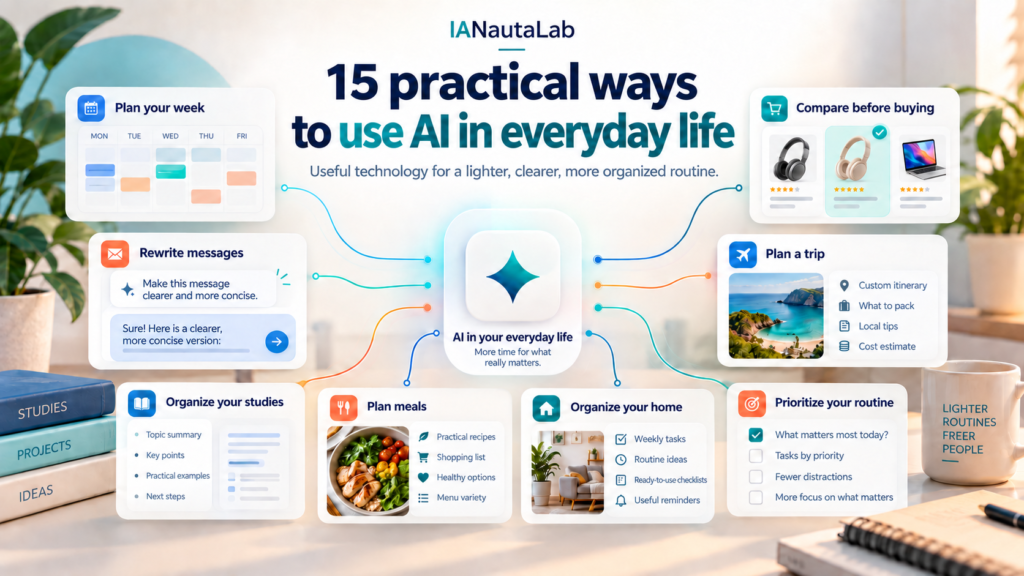
The 15 ideas below cover organization, communication, practical life, and learning. You do not need to try all of them or purchase a service to get started: choose a tool you already have access to and a small task you can check. If you are still learning to talk to an assistant, see our guide to getting started with ChatGPT; this article’s principles do not depend on a brand.
Before you start: provide context without handing over your whole life
A useful request usually includes a goal, necessary context, constraints, and a desired format. “Organize my tasks” leaves a lot open; “I have 40 free minutes and three tasks, one of which depends on someone else’s reply; propose an order and explain why” provides conditions for a better suggestion. OpenAI’s official request guidance recommends clarity, context, and successive adjustments. Start simply, read the answer, and correct what does not work.
Use fictional examples or remove names, addresses, and other unnecessary data. Check facts, numbers, deadlines, and instructions against their original sources. A well-written AI text is still a draft, not confirmation.
Organization: get tasks out of your head and put them in order
1. Prioritize what fits into your day
When everything seems urgent, describe the tasks, available time, and anything that depends on someone else. Ask for a possible order, not a perfect schedule. AI can separate what needs to happen today from what can be negotiated, suggest short blocks, and flag conflicts. This helps especially when you are facing a long list without knowing where to start.
Example request: “I have 90 minutes today. I need to answer two simple emails, review a four-page document, and schedule a conversation that depends on someone else’s availability. Suggest a realistic order, allow a ten-minute buffer, and say what I should postpone if time runs out.” Before following it, check whether the durations make sense for you; do not let the assistant send messages or change appointments without review.
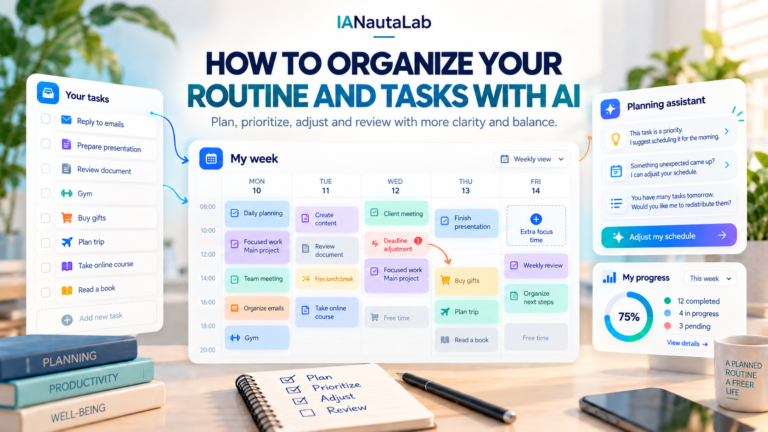
2. Build a week with room for unexpected events
A week becomes more manageable when you show fixed times, flexible tasks, and periods when you usually have more energy. Instead of asking AI to “optimize” every minute, ask for a plan with breathing room and priorities. The expected result is a distribution outline, not events automatically added to your calendar.
It helps to mention that Tuesday is already full or that an activity requires travel. Then look at the plan as you would a route: is there time between appointments? Has an important task been squeezed into the end of the day? Adjust the blocks to your situation and confirm times with the people involved.
3. Turn scattered notes into an action list
After a conversation or a busy day, notes such as “check budget,” “call school,” and “maybe Saturday” mix decisions, questions, and reminders. Paste only passages you can share and ask AI to separate actions, open questions, and reference information. It can return a list with clear verbs and indicate what still lacks an owner or deadline.
Example request: “Organize these fictional notes into three groups: confirmed actions, pending decisions, and supporting information. Do not invent dates or owners. If something is ambiguous, mark it as a question: ‘check budget; visit maybe Saturday; confirm time; bring materials.’” Compare the output with your notes. An item that looks like a decision may only have been a possibility mentioned in the conversation.
4. Break a large task into verifiable steps
“Organize household documents” or “prepare a move” is too big to fit into an afternoon. Say what result you want, your deadline, and the resources you have. Ask for small steps, dependencies, and a first action that fits the available time. AI can help reveal that, before putting papers away, you need to choose categories, set aside a box, and decide what to digitize.
Review the sequence before starting. It may assume you have equipment or help that you do not. Remove unnecessary steps and confirm real requirements with appropriate sources; the list helps you start doing the work, not establish a universal rule.
If the list has become a recurring problem, the guide to organizing your routine and tasks with AI shows how to turn it into a plan that accommodates priorities and unexpected events.
Communication: find a clear way to say what matters
5. Shorten a message without losing your voice
Have you written a long message and noticed that the main question was buried in the middle? Provide a draft without sensitive data and explain what the recipient needs to understand or do. Ask for a shorter version preserving the facts, tone, and final request. It is useful for routine emails, group messages, and invitations, without turning your writing into an artificial formula.
Example request: “Reduce this message to no more than 90 words. Keep the friendly tone, the date still undecided, and the request for a reply by Friday. Do not add promises. Text: [paste only the necessary passage].” Compare line by line. AI may remove an important qualification or sound more abrupt than you want; the version you send should be yours.
For more careful work on a draft, tone, and final version, see the guide to writing and improving everyday texts with AI.
6. Prepare a delicate conversation before starting it
If you need to discuss shared tasks, a delay, or mismatched expectations, ask for help organizing the points: observed fact, practical effect, question to ask, and possible agreement. The result can be a topic outline, not a speech to pressure the other person. It helps replace vague accusations with concrete examples and an opening to listen.
Example request: “I’m going to talk with someone in my household about sharing the cleaning. I need to explain that Sunday tasks have had no assigned owner, hear their perspective, and propose an arrangement for next month. Suggest four topics for a respectful conversation without attributing intentions.” Review the tone and be willing to change the plan during the real conversation. AI does not know the other person’s side.
7. Approach a service call with better questions
Before calling a company, school, or service provider, list what you need to find out. Tell AI your goal, what you have already been told, and what remains uncertain; ask for questions in priority order and space to record answers. This helps avoid ending the call without asking about deadlines, documents, next steps, or who will respond.
Do not provide contract numbers, personal documents, or other people’s data just to build the outline. Verify any suggested procedure through the official channel; service rules change. During the conversation, record the actual answer rather than treating the generated list as the institution’s policy.
Practical life: plan around constraints that actually exist
8. Make a shopping list based on what you already have
A generic list often repeats items already in the cupboard. Describe simply what you have, how many days you want to plan for, and which items to avoid. AI can group purchases by section and separate essentials from optional items. It does not know prices, store stock, or what is actually in your refrigerator.
Example request: “I have rice, beans, oats, and three vegetables at home. I want a shopping list for simple meals over four days for two people, without excessive quantities. Separate produce, proteins, and pantry items; mark what I can use from what I already have.” Check portions, expiration dates, preferences, and any dietary restrictions using appropriate sources and guidance.
9. Organize preparations for a short trip
A weekend trip involves more than destinations. There are departure times, transportation, luggage, reservations, and small things to do before closing the door. Specify the type of travel, duration, and luggage limit; ask for a checklist separated into “before leaving” and “bring.” The benefit is reducing predictable omissions without relying on a huge list copied from the internet.
If the answer mentions required documents, schedules, prices, transportation rules, or attraction opening hours, confirm everything against current official sources. AI can remind you to check; it should not be the final authority on those details. Avoid pasting reservation numbers or personal documents into the conversation.
10. Compare choices using your criteria, not a generic winner
When deciding between two office chairs, delivery services, or courses, start with criteria that matter to you: space, maximum budget, deadline, ease of use, and cancellation terms, for example. Ask for a simple matrix distinguishing confirmed facts, missing data, and personal preferences. AI can reveal missing questions, but should not invent specifications or choose for you.
Example request: “I’m comparing two chairs. Option A fits the space and has a stated two-year warranty; for option B, I only know the measurements and price. Organize space, ergonomics, warranty, and cost in a table. Mark missing data as ‘not provided’ and suggest what to ask the seller, without declaring a winner.” Check measurements and terms on official pages before buying.
11. Share household tasks in a way you can negotiate
A shared routine does not improve with a schedule that ignores availability and preferences. Explain which tasks exist, how often they occur, and when each person is usually available, without exposing private details. Ask for two ways of dividing them and a simple rotation. The result can open a conversation, not impose an agreement.
Check whether the proposal also balances invisible work: remembering purchases, tracking maintenance, and replacing supplies take time. Ask the people involved what they consider fair and adapt the schedule. If AI assigned someone a task without agreement, treat it as a hypothesis, not a decision already made.
12. Find a way to use leftover ingredients
When there are few items at home, ask for preparation ideas based on a short list of ingredients, utensils, and available time. You can request two options: one quick and one to prepare at leisure. This is a creative, economical use of planning, different from asking for a “perfect” recipe without context.
Check that combinations are feasible and preparation follows appropriate hygiene, storage, and cooking practices. For allergies, medical restrictions, or children’s nutrition, do not rely only on the assistant’s answer; follow professional advice and labels. A dish suggestion is a starting point you can adapt to what you actually have.
Learning and ideas: use the answer to think better
13. Ask for an explanation of a difficult text
A manual, notice, or instruction may use terms that hinder understanding. Paste a short passage you have the right to share and ask for a plain-language explanation that retains important terms. AI can separate “what the text says,” “what remains unclear,” and “questions for the person responsible.” This helps you return to the original source with more precise questions.
Example request: “Explain this passage in plain English without changing its numbers or adding rules. Write a four-line summary, then list two questions I should confirm with the issuer: [passage].” Return to the document. For contracts, health, finances, or rights, a paraphrase does not replace professional guidance or the official version.
14. Create questions to test what you learned
After studying a page of your own notes, ask for questions at different levels: one recall question, one application question, and one comparison question. Try answering before asking for the answer key. AI can reveal gaps that passive rereading does not show, but the questions and answers can also contain errors.
Compare the answer key with the original material or a reliable source. If a question concerns something absent from your notes, ask for it to be removed. Use the tool as a practice partner, not an authority that independently corrects everything studied. For a broader introduction, read what artificial intelligence is and how to get started.
15. Generate directions for a personal project without choosing blindly
You want to start a small vegetable garden, organize a reading meetup, or return to a hobby, but do not know which format fits your routine. Describe your goal, space, materials, and time, and ask for three genuinely different approaches with their main obstacles. The value lies not in producing dozens of ideas but in seeing options you can compare.
Example request: “I want to start an informal reading club for four people. We have one hour a month, online meetings, and nobody wants a long assignment between meetings. Propose three distinct formats, with a simple first action for each and one risk of dropping out to watch for.” Choose an alternative with the group and test it on a small scale. Real people’s acceptance matters more than the generated plan’s creativity.
What should you check before using an AI answer?
Start with what could cause harm if wrong: dates, rules, numbers, addresses, prices, safety instructions, and assignments to other people. The NIST generative AI profile describes the risk of factually incorrect answers presented confidently. Open the original source and check the relevant passage. When a task involves health, rights, money, or safety, use AI to organize questions and seek the appropriate source or professional for the decision.
Also review suitability: does the proposal respect your time, budget, the people involved, and what you actually asked for? Remove sensitive information before sending a request. If the answer seems good but relies on a wrong premise, identify that premise and ask for a revision. You do not need to accept or discard everything at once.
Choose one use to try today
Pick a small, verifiable task, such as turning five notes into actions or shortening a message. Write your goal, two constraints, and the desired format. Read the first answer, correct one premise, and compare the two versions. Then carry out only what you have checked yourself. For help structuring that first request, the Everyday task prompt generator organizes your choices into an instruction you can adapt before using. The best outcome of this experience is not an attractive text: it is a real task that became clearer and remained under your control.